


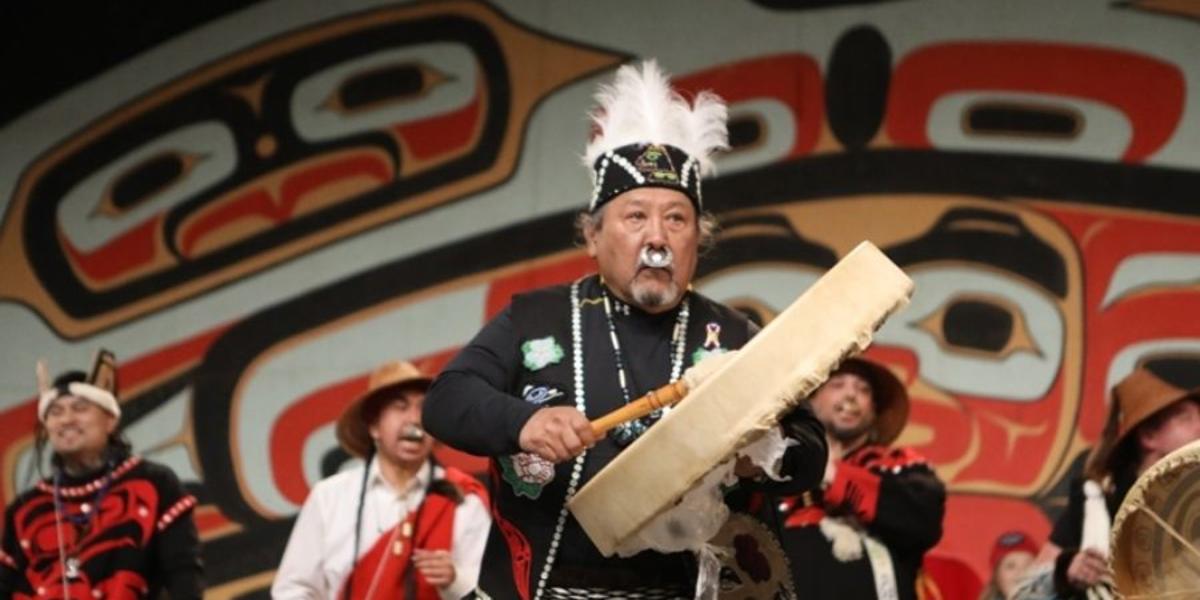
 Credit: (c) Sealaska Heritage Institute
Celebration 2026
For the past several months, Alaska Native people from all over Southeast Alaska have been preparing for Celebration 2026, the largest gathering of Tlingit, Haida and Tsimshian people in the world. Grandmothers and aunties have been beading and sewing regalia. Artists have been busy carving, weaving and building inventory for the artist market. Tribal members have been hunting seal or harvesting seaweed and berries for the traditional foods contest. Out-of-town relatives are making airline or ferry reservations to travel to Juneau. Dance group leaders started song practices to ensure everyone knows the words and harmony for clan songs.
Meanwhile, the staff at Sealaska Heritage Institute (SHI) are exceptionally busy planning and structuring work schedules around the 4-day event which will take place in Juneau, Alaska June 3-6, 2026.
Celebration is a biennial event that brings together over 1,600 Tlingit, Haida and Tsimshian dancers representing more than 35 dance groups. In addition to the traditional dance performances, Celebration-related events include a Juried Art Show and Competition, a Juried Youth Art Exhibit, a Toddler Regalia Review, a Native Artist Market, a parade through downtown, and Native food contests.
Visitors coming to Juneau in the first week in June should absolutely include time in their schedules to attend the performances and browse through the Native Artist Market. The event is centrally located in downtown Juneau so throughout the weekend visitors will see participants in colorful regalia and elaborate jewelry walking through the streets or grabbing a quick meal in local restaurants.
There are three main venues for Celebration. Centennial Hall is the main and largest facility, while two blocks away the Elizabeth Peratrovich Hall offers a more intimate setting to take in the performances. The Sealaska Heritage Arts Campus in the center of downtown, also two blocks away from Centennial Hall, will host the Native Artist Market. The Sealaska Heritage Arts Campus facilities feature monumental art, a traditional clan house, the Indigenous Science Building, the Sealaska Heritage Store and an exhibit featuring art and objects from the Juried Art Show.
Visitors unable to attend performances inside one of the venues have the opportunity to see dance groups as they line up in the street for the grand entrance and opening ceremony, the parade through downtown, and then again on the final evening for the grand exit, which signals the end of Celebration.
The dances and songs carry significant meaning behind them and are most commonly performed during traditional ceremonies. In Tlingit culture, songs, names and crests that appear on regalia or art objects all belong to particular clans. They are often representations of historical events and have been passed down through generations. Celebration is one of the few times the songs and dances are not affiliated with ceremony or more serious cultural events.
During the performances, visitors will often see members of the audience hold their hands and arms up and in an open position, or sometimes they will stand up. This is a gesture that acknowledges relationships or kinship to the people on stage singing. Southeast Alaska Native people are members of either the Eagle or Raven clan. They follow their mother’s lineage. Members of the same clan are considered brothers or sisters even if there is no biological relationship and are expected to marry someone from the opposite clan. A big part of Tlingit culture is the relationship between opposite clans. The Tlingit value system defines the responsibility of balance, obligation and reciprocity between opposite clan members.
Visitors to Juneau commonly wonder if it is ok to purchase clothing, jewelry or other merchandise that features Alaska Native art or symbols. As a general rule, Native artwork that is made available for purchase to the public is completely fine for non-Native individuals to own and wear. In fact, the artists are happy to share their culture in this manner. Retailers and vendors are prohibited by law from falsely claiming an object is Native made. If uncertain it is in the buyer’s best interest to ask or confirm if a product is Native made or not.
The fact that Alaska’s capital city is the host to one of the largest Indigenous gatherings and celebration of their culture is quite noteworthy given the less-than-perfect history between Alaska Natives and the western world. In the early 1800s, when western explorers first came to Southeast Alaska, they initially acknowledged Native ownership of land and resources and recognized that Native people had advanced societies and were governed by longstanding property law. However, as more explorers came and took note of the abundance and value of natural resources, the US military, Christian institutions and American laws worked in unison to successfully oppress Native cultures and languages and disenfranchise Native people from their ancestral lands. Alaska Native people fought for the right to be recognized as citizens which afforded them the right to vote. Over decades, they strategically worked the legal and political structure to secure a land settlement and legal status as tribes.
Celebration is a testament to the resiliency of Southeast Alaska Native people. But it is also a commemoration of Native inclusivity. The non-Native community of Juneau, in recent years, has embraced Tlingit culture, art and language. As a result, the city has built a reputation as a thriving art community and a population that values the natural surroundings and bountiful resources.
Lorem Ipsum
is simply dummy text of the printing and typesetting industry. Lorem Ipsum has been the industry's standard dummy text ever since the 1500s, when an unknown printer took a galley of type and scrambled it to make a type specimen book. It has survived not only five centuries, but also the leap into electronic typesetting, remaining essentially unchanged. It was popularised in the 1960s with the release of Letraset sheets containing Lorem Ipsum passages, and more recently with desktop publishing software like Aldus PageMaker including versions of Lorem Ipsum.
Lorem Ipsum
is simply dummy text of the printing and typesetting industry. Lorem Ipsum has been the industry's standard dummy text ever since the 1500s, when an unknown printer took a galley of type and scrambled it to make a type specimen book. It has survived not only five centuries, but also the leap into electronic typesetting, remaining essentially unchanged. It was popularised in the 1960s with the release of Letraset sheets containing Lorem Ipsum passages, and more recently with desktop publishing software like Aldus PageMaker including versions of Lorem Ipsum.
Lorem Ipsum
is simply dummy text of the printing and typesetting industry. Lorem Ipsum has been the industry's standard dummy text ever since the 1500s, when an unknown printer took a galley of type and scrambled it to make a type specimen book. It has survived not only five centuries, but also the leap into electronic typesetting, remaining essentially unchanged. It was popularised in the 1960s with the release of Letraset sheets containing Lorem Ipsum passages, and more recently with desktop publishing software like Aldus PageMaker including versions of Lorem Ipsum.
Lorem Ipsum
is simply dummy text of the printing and typesetting industry. Lorem Ipsum has been the industry's standard dummy text ever since the 1500s, when an unknown printer took a galley of type and scrambled it to make a type specimen book. It has survived not only five centuries, but also the leap into electronic typesetting, remaining essentially unchanged. It was popularised in the 1960s with the release of Letraset sheets containing Lorem Ipsum passages, and more recently with desktop publishing software like Aldus PageMaker including versions of Lorem Ipsum.